Choosing the right running shoes is about much more than picking a popular brand, an attractive colour, or the latest design. The shoes you wear should fit your feet comfortably, suit your running style, and provide the grip and cushioning you need for your usual routes.
For example, someone who runs 3 km around a neighbourhood park may have different footwear needs from a marathon runner training on city roads. Similarly, a person with wide feet may find a shoe uncomfortable even if it receives excellent reviews from other runners.
In India, running conditions can vary significantly. You might run on concrete pavements in Ahmedabad, park paths in Bengaluru, coastal roads in Mumbai, or wet surfaces during the monsoon. Your choice of running shoes should reflect these practical conditions.
The best running shoes are the ones that fit your feet well, feel comfortable while running, and suit your training needs. You do not necessarily need the most expensive pair or a shoe designed for professional athletes.
This guide explains how to choose running shoes according to foot shape, shoe size, cushioning, arch comfort, terrain, and running goals. It also includes comparison tables, practical examples, Indian running data, and tips to help you make a more confident purchase.
Why Choosing the Right Running Shoes Matters
Running places repeated loads on your feet and legs. A suitable pair of shoes can make running more comfortable by providing an appropriate fit, cushioning, traction, and stability for your needs.
The wrong fit, on the other hand, may contribute to problems such as blisters, toe pressure, discomfort, or irritation during longer runs.
Here are some important reasons to choose your running shoes carefully.
1. Better Comfort During Running
A shoe with enough room in the toe box, a secure heel, and a comfortable upper can help you focus on your run instead of constantly adjusting your footwear.
2. Support for Your Training Goals
Running shoes are designed for different purposes, including easy runs, long-distance training, speed sessions, trail running, and racing. Choosing a shoe that matches your activity can improve comfort and practicality.
3. Suitable Cushioning and Shock Absorption
Cushioning changes how a shoe feels underfoot. Some runners prefer a softer ride, while others prefer a firmer and more responsive feel. Neither is automatically best for everyone.
4. Improved Grip on Different Surfaces
Road shoes, trail shoes, and everyday running shoes can have different outsole patterns. Choosing the right grip can be particularly useful when running on wet pavements, gravel, or uneven paths.
5. Fewer Fit-Related Problems
A shoe that is too short, too narrow, or poorly secured can increase friction and pressure. A suitable fit may help reduce problems caused by the footwear itself, although no shoe can guarantee injury prevention.
Features to Look for When Buying Running Shoes
Before comparing brands or models, understand the features that influence comfort and performance.
| Shoe feature | What it does | What to check |
|---|---|---|
| Toe box | Provides space for the toes | Toes should be able to spread and move without painful pressure |
| Heel fit | Helps keep the shoe secure | The heel should not slip excessively |
| Cushioning | Influences impact feel and comfort | Choose a level of cushioning that feels comfortable for your runs |
| Midsole | Affects firmness, flexibility, and responsiveness | Check whether the shoe feels stable and comfortable underfoot |
| Outsole | Contacts the ground | Look for suitable grip for your usual running surface |
| Upper material | Wraps around the foot | Choose a breathable, comfortable fit without rubbing |
| Lacing system | Helps secure the midfoot | The shoe should feel snug without pressure or numbness |
| Weight | Affects the overall feel of the shoe | Balance lightness with comfort, grip, and durability |
| Width | Determines space across the foot | Consider standard, wide, or other available fits |
| Durability | Affects how the shoe holds up over time | Inspect the outsole and consider your running frequency and surfaces |
These features work together. A shoe with excellent cushioning may still be unsuitable if it squeezes your toes or allows your heel to move too much.
Step 1: Understand Your Foot Shape and Width
The first step in choosing running shoes is to understand the shape and size of your feet. Feet differ in length, width, toe shape, and arch height. Two people who wear the same shoe size may need very different shoe designs to feel comfortable.
Common Foot Shapes and What to Consider
| Foot characteristic | Possible fitting challenge | What to look for |
|---|---|---|
| Wide forefoot | Toes feel squeezed | A wider toe box or wide-width model |
| Narrow heel | Heel slips while running | A secure heel fit and adjustable lacing |
| High instep | Pressure across the top of the foot | A comfortable upper and suitable lacing space |
| Low or flat arch | Some shoes may feel uncomfortable or unstable | Try different models and select the one that feels comfortable and secure |
| High arch | Some shoes may feel too firm or restrictive | Compare cushioning, flexibility, and overall comfort |
| Different-sized feet | One shoe feels tighter than the other | Fit the larger foot and assess both shoes individually |
Having flat feet or high arches does not automatically mean you need a particular type of shoe. Foot structure is only one factor; comfort, running history, movement, and any existing symptoms also matter.
If you experience persistent pain, a sports physiotherapist, podiatrist, or other qualified healthcare professional can help assess whether a particular footwear feature or treatment is appropriate.
Step 2: Choose the Correct Shoe Size
One of the most common mistakes is buying running shoes in the same size as casual footwear without checking the actual fit.
Shoe sizing can vary between brands and models. Your feet can also change over time, and one foot may be slightly larger than the other.
How Much Space Should You Leave in the Toe Box?
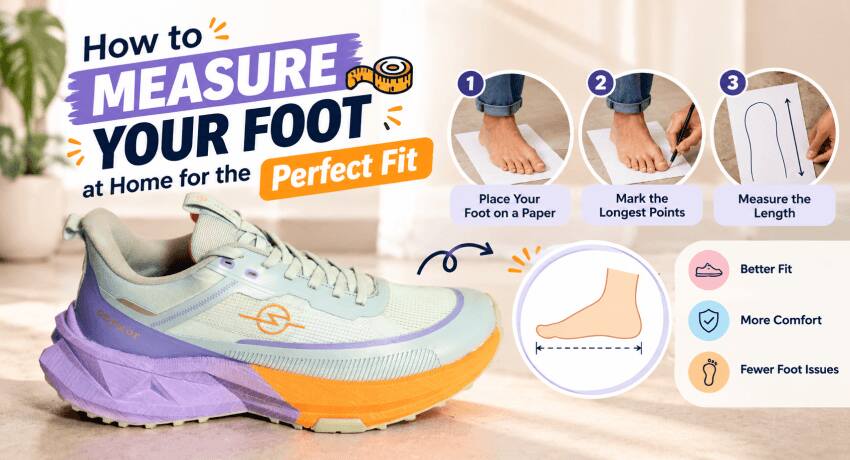
A commonly recommended starting point is approximately 10–12 mm of space between your longest toe and the front of the shoe. This is a practical fitting guideline, not a rigid rule for every foot or shoe design.
Your toes should be able to move comfortably without hitting the front of the shoe when you walk or jog.
Tips for Getting the Right Fit
- Try shoes later in the day, when your feet may be more swollen than they are in the morning.
- Wear the socks you normally use for running.
- Try on both shoes, not just one.
- Stand up and check whether your toes can move freely.
- Walk, jog, or run a few steps if the store permits it.
- Make sure the heel feels secure without painful rubbing.
- Check for pressure around the toes, sides, arch, and top of the foot.
Do not buy a shoe that feels painful on the assumption that it will become comfortable after several runs. Running shoes should feel comfortable from the start.
Example
Suppose you usually wear UK size 8 casual shoes. A particular running shoe in UK size 8 may fit well, while another brand’s size 8 may feel short or narrow.
Instead of relying only on the number printed inside the shoe, compare the actual fit. If size 8 presses against your toes but size 8.5 provides a secure heel and enough forefoot room, the larger size may be the better option in that model.
The correct size is the one that fits your feet properly not necessarily the size you have always purchased.
Step 3: Choose the Right Cushioning
Cushioning is the material and design in the midsole that influences how the shoe feels underfoot. Some running shoes have a soft, plush feel, while others are firmer and more responsive.
The right choice depends on personal preference, running distance, comfort, and the shoe’s overall design.
Types of Running Shoe Cushioning
| Cushioning type | Typical feel | May suit |
|---|---|---|
| Minimal cushioning | Close-to-ground feel | Experienced runners who specifically prefer this design |
| Moderate cushioning | Balanced feel | Everyday training and general running |
| Maximum cushioning | Thick, often soft underfoot | Runners who prefer a plush ride |
| Responsive cushioning | Springy or energetic feel | Runners who prefer a more lively sensation during faster sessions |
These categories are not perfectly standardised across brands. Two shoes labelled “maximum cushioning” may feel very different.
Is More Cushioning Always Better?
No. A softer shoe may feel comfortable to one runner but unstable or awkward to another. A firmer shoe may feel responsive to one person and uncomfortable to someone else.
Do not choose cushioning based only on marketing claims or the assumption that extra foam guarantees fewer injuries. Compare the shoe’s comfort, stability, and fit while moving.
For example, a beginner who runs 3 km at an easy pace may be comfortable in a moderate-cushioning daily trainer. A runner preparing for longer distances may prefer a more cushioned model, provided it fits well and feels stable.
Step 4: Understand Arch Support and Pronation
Pronation is the natural inward movement of the foot as it adapts to contact with the ground. Some degree of pronation is normal.
You may hear terms such as neutral running shoes, stability shoes, and motion-control shoes. These describe different approaches to shoe construction and support.
Common Running Shoe Categories
| Shoe category | General characteristics | What to consider |
|---|---|---|
| Neutral running shoes | Generally do not include strong pronation-control features | Suitable for many runners who find them comfortable and stable |
| Stability running shoes | Include design features intended to influence foot movement or provide a guided feel | May suit runners who prefer the added support, but comfort remains important |
| Motion-control shoes | Often designed with more structured support features | Best assessed according to individual needs rather than foot shape alone |
A flat arch does not automatically mean that you need a stability shoe. Similarly, a high arch does not automatically require a particular cushioning system.
Research on running footwear does not support one universal shoe category as the best way to prevent injuries for every runner. Comfort, individual response, and training habits all matter.
If you have recurring foot, ankle, knee, or leg pain, avoid trying to diagnose your gait from a quick online test alone. A qualified professional can assess your symptoms and help determine whether footwear changes, exercises, or other treatment may be useful.
Step 5: Select Shoes According to Your Running Surface
Your running surface is another important factor. Shoes intended for smooth roads may not provide the same traction as those designed for muddy or rocky trails.
Running Shoes for Different Surfaces
| Running surface | Recommended shoe characteristics | Example use |
|---|---|---|
| City roads and pavements | Comfortable cushioning and durable road grip | Daily runs in Ahmedabad, Pune, or Delhi |
| Park paths | Versatile outsole and comfortable upper | Morning runs in a neighbourhood garden |
| Treadmill | Comfortable fit and suitable cushioning | Indoor gym sessions |
| Gravel and uneven trails | More protective construction and stronger traction | Trail running on loose or rocky ground |
| Wet routes | Reliable grip suited to the surface and conditions | Monsoon running on damp paths |
| Track workouts | A shoe suited to the track and workout intensity | Faster intervals or structured training |
What About Running During the Indian Monsoon?
Rainy weather creates additional footwear considerations. Wet surfaces can become slippery, and shoes that remain damp may feel uncomfortable. For monsoon running:
- Choose an outsole with dependable grip for your usual routes.
- Avoid assuming that a waterproof upper will always be better; waterproof shoes can retain heat and moisture in warm conditions.
- Use moisture-managing socks that fit properly.
- Let shoes dry naturally after running in the rain.
- Avoid running on slippery tiles, flooded paths, or surfaces where you cannot judge the footing.
If you frequently run on trails, look specifically at trail-running shoes rather than assuming a standard road shoe will work equally well on loose terrain.
Step 6: Consider Breathability and Upper Material
India’s warm and humid weather makes breathability a practical consideration for many runners.
The shoe’s upper should allow a comfortable fit without excessive heat, rubbing, or pressure. Mesh uppers are common because they can allow airflow, although breathability varies by construction.
What to Look For
Breathable mesh: May help heat escape during warm-weather runs.
Comfortable lining: Should not rub against the skin or create pressure points.
Secure midfoot fit: Helps keep the foot in place without making the shoe feel tight.
Suitable protection: Trail runners may prefer stronger protection around the toes and sides.
Appropriate socks: Moisture-managing running socks may help reduce discomfort from wet fabric and friction.
For example, someone running at 6 a.m. in humid Mumbai may value airflow, while a trail runner may prioritise protection and grip over maximum ventilation.
Step 7: Match the Shoes to Your Running Goals
You do not need the same footwear for every type of running. A daily training shoe, a trail shoe, and a racing shoe may serve different purposes.
Which Running Shoe Type Should You Choose?
| Running goal | Useful characteristics | Practical advice |
|---|---|---|
| Beginner jogging | Comfortable fit, manageable cushioning, dependable grip | Prioritise comfort over advanced features |
| Daily fitness runs | Durability, comfort, versatile performance | Look for a reliable everyday trainer |
| Long-distance running | Comfortable fit over longer periods and suitable cushioning | Test the shoe on progressively longer training runs |
| Speed training | A responsive feel and secure fit | Make sure the shoe remains comfortable at faster paces |
| Trail running | Stronger traction and appropriate foot protection | Match the outsole to the terrain |
| Race day | A fit and ride suited to your event and pace | Practise in the shoe before race day |
Example: Beginner vs Marathon Runner
A beginner running three times a week may benefit most from a comfortable, durable daily trainer. A marathon runner may choose a shoe that feels comfortable over long distances and another model for faster sessions.
Neither runner necessarily needs the most expensive shoe. The correct choice depends on training demands and individual comfort.
Step 8: Check the Outsole, Grip, and Flexibility
The outsole is the part of the shoe that contacts the ground. Its material and pattern influence traction and durability.
A smooth outsole may work well on many paved routes, while deeper lugs can be useful on loose trails. However, aggressive trail lugs may feel less comfortable on hard, smooth roads.
When checking a shoe:
- Look for an outsole suited to your regular terrain.
- Check that the shoe does not feel slippery on a safe test surface.
- Make sure the shoe bends naturally where your foot bends, rather than folding awkwardly through the middle.
- Look for a secure heel and comfortable midfoot.
- Avoid shoes that feel unstable or force your foot into an uncomfortable position.
Do not use a single flexibility or twisting test as the only measure of quality. Different running shoes are deliberately built with different levels of stiffness.
Step 9: Set a Realistic Budget
Running shoes are available at many price points in India. A higher price may reflect advanced foam, lighter materials, specialist construction, or brand positioning, but it does not guarantee a better fit.
Instead of starting with the most expensive models, identify your budget and compare the features that matter for your running.
How to Compare Running Shoes Within Your Budget
| Priority | What to evaluate |
|---|---|
| Essential | Proper size, comfortable toe box, secure heel |
| Very important | Suitable grip, cushioning, and upper fit |
| Useful | Durability, breathability, and intended-use features |
| Optional | Premium racing technology or specialist materials you may not need |
For a beginner, a comfortable daily trainer may be a better investment than a premium racing shoe designed for a different purpose.
Check the seller’s return policy, especially when shopping online. If you cannot try the shoe in person, review the brand’s size chart, width options, and return conditions before ordering.
Indian Running Facts: Why Comfort and Footwear Choices Matter
Running is becoming increasingly visible in India’s recreational fitness culture, with city races and community events attracting large numbers of participants. However, event participation figures should not be confused with national running participation rates.
For context, the 2025 Vedanta Delhi Half Marathon had 39,513 participants, including 9,709 women. Women represented approximately 24.6% of the reported participant total. These figures describe one major event, not the proportion of women who run across India.
An older Indian study of 50 recreational runners reported that 88% experienced pain associated with running, with the knee identified as the most commonly reported pain site at 27%. Because the sample was small and the study is more than a decade old, these percentages should not be treated as estimates for all Indian runners. They do, however, illustrate why comfort, sensible training, and attention to symptoms matter.
| Indian running data | Reported figure | Important context |
|---|---|---|
| Participants in the 2025 Vedanta Delhi Half Marathon | 39,513 | One event, not a national running census |
| Women participants in that event | 9,709 | Approximately 24.6% of the reported total |
| Runners reporting pain in a small Indian recreational-running study | 88% | Survey of only 50 runners; not representative of all runners |
| Knee reported as the most common pain site in that study | 27% | Study-specific finding; not a national injury rate |
These numbers do not prove that poor shoes caused the reported pain. Running discomfort can have many contributing factors, including training load, recovery, running technique, strength, terrain, and previous injury.
The practical takeaway is to choose shoes that fit well, build running distance gradually, and seek appropriate advice when pain persists.
How to Test Running Shoes Before Buying
A short fitting session can help you identify obvious problems before committing to a pair.
A Simple 7-Step Shoe-Fitting Checklist
- Measure your feet. Check both feet and fit the larger one comfortably.
- Wear running socks. Use the type you normally wear during training.
- Check toe space. Leave enough room for your longest toe and make sure your toes can move freely.
- Secure the heel. The heel should feel held in place without painful rubbing.
- Check the upper. There should be no tight spots, pinching, or uncomfortable pressure.
- Walk and jog. Test the shoes in motion if possible.
- Compare comfort. Try at least two suitable options and choose the one that feels best for your feet and intended running.
A shoe may feel different after several kilometres, so do not rely entirely on how it looks or feels while standing still.
If buying online, make sure the seller offers a clear size chart and a reasonable return or exchange policy.
Common Mistakes to Avoid When Buying Running Shoes
1. Choosing Shoes Only by Brand
A brand may offer several excellent shoes, but that does not mean every model will fit your feet. Compare individual models rather than assuming brand loyalty guarantees comfort.
2. Buying a Smaller Size for a Snug Fit
A tight shoe can press against your toes and create discomfort. Your foot should feel secure, not squeezed.
3. Assuming Expensive Shoes Prevent Injuries
No shoe can guarantee injury prevention. Fit, training progression, strength, recovery, and individual health factors also play important roles.
4. Choosing Based Only on Arch Height
Flat feet or high arches do not automatically determine the best shoe category. Evaluate comfort and function rather than relying on a simple foot-shape label.
5. Using Road Shoes for Every Trail
Road shoes may not provide the traction or protection required on loose, muddy, or rocky terrain.
6. Ignoring Early Signs of Wear
Worn cushioning, damaged uppers, a deteriorating outsole, or a change in comfort can indicate that a pair needs replacing. The right timing varies with the shoe, runner, terrain, and training volume.
7. Increasing Running Distance Too Quickly
Even suitable shoes cannot compensate for a sudden increase in training load. Build distance and intensity gradually and allow time for recovery.
When Should You Replace Your Running Shoes?
There is no single mileage figure that works for every running shoe. Replacement depends on the model, runner, terrain, frequency of use, and how the shoes feel.
A commonly used reference range is approximately 300–500 miles (about 480–805 km), but this is a rough guide rather than a strict deadline. Some shoes may wear out sooner, while others may remain comfortable for longer. Look for these signs:
- The outsole has visibly worn down.
- The midsole looks compressed or feels noticeably different.
- The shoe has developed tears or lost its secure fit.
- You experience new rubbing or discomfort that was not present before.
- The shoes no longer feel as comfortable during your usual runs.
Do not replace shoes solely because they have reached a particular number of kilometres if they remain in good condition, and do not continue using visibly damaged or uncomfortable shoes simply because they have not reached that mileage.
Frequently Asked Questions
1. How do I choose the right running shoes for my feet?
Start by measuring both feet and checking length, width, toe space, and heel fit. Then consider cushioning, grip, terrain, and running goals. Try the shoes on with running socks and walk or jog in them before deciding.
2. Should running shoes be one size bigger?
Not necessarily. Some runners need a larger size than their casual shoes, while others do not. A practical starting point is around 10–12 mm of space in front of the longest toe, with a secure heel and no uncomfortable pressure. Choose according to actual fit rather than automatically sizing up.
3. Are cushioned running shoes better?
Not for everyone. Cushioning affects how a shoe feels, but more cushioning does not automatically mean better comfort or fewer injuries. Compare the shoe’s overall fit, stability, and feel during running.
4. Which running shoes are best for flat feet?
There is no universal answer. Some runners with flat feet prefer stability shoes, while others are comfortable in neutral shoes. Consider your individual comfort and running history, and seek a professional assessment if you have recurring pain.
5. Are expensive running shoes worth the money?
They can be worth it if their features meet your needs, but price alone does not determine suitability. A reasonably priced shoe that fits well may be a better choice than a premium shoe that causes discomfort.
6. Can I use walking shoes for running?
Some athletic shoes are designed for both walking and light exercise, but dedicated running shoes may be more suitable for regular running. If you run frequently, choose footwear designed for your training and make sure it feels comfortable at running speed.
7. Which running shoes are suitable for Indian weather?
For hot and humid conditions, consider a comfortable, breathable upper and moisture-managing socks. During monsoon running, grip and safe route selection become particularly important. Waterproof construction is not automatically the best choice in hot weather.
8. How long do running shoes last?
A rough reference range is 300–500 miles, or approximately 480–805 km, but actual lifespan varies. Check the outsole, midsole, fit, and comfort instead of relying on mileage alone.
9. Should beginners buy special running shoes?
Beginners generally benefit from a comfortable daily running shoe with a secure fit and suitable cushioning. Specialised racing or trail models are only necessary when they match the runner’s goals and terrain.
10. Can the wrong running shoes cause foot pain?
Poor fit can contribute to blisters, pressure, and discomfort. However, running pain can also arise from training load, technique, injury, or other factors. Persistent or worsening pain should be assessed by a qualified healthcare professional.
Conclusion
Choosing the right running shoes becomes much easier when you focus on your own feet instead of following trends. Start with a comfortable fit, enough toe space, a secure heel, and a shoe that suits the surface on which you run. Then compare cushioning, breathability, grip, durability, and budget.
For Indian runners, practical details such as heat, humidity, monsoon conditions, and the difference between city pavements and park trails can also influence the decision.
Remember that the best running shoe is not necessarily the most expensive or the most popular, it is the one that fits comfortably and works well for your running needs. Test the fit, increase your training gradually, and pay attention to persistent pain rather than assuming new shoes will solve every problem.
Health Disclaimer
This article is for general educational purposes and does not replace individual medical advice. If you experience persistent foot, ankle, knee, or leg pain, numbness, swelling, or difficulty running, consult a qualified healthcare professional. People with diabetes, reduced foot sensation, or existing foot conditions may need specialised footwear advice.