Buying shoes that look great is easy. Finding a pair that actually fits your feet comfortably throughout the day can be a little more challenging. Shoes that are too tight may cause blisters, pressure points, and discomfort, while oversized footwear can allow your feet to slide, making walking less stable. Even when you know your usual shoe size, the fit can vary between brands, styles, and shoe designs.
The good news is that you do not need to visit a shoe store to find your measurements. With a sheet of paper, a pencil, a ruler or measuring tape, and a few minutes, you can measure your feet at home and use those measurements to make more informed footwear choices.
Learning how to measure your foot correctly is especially helpful when shopping online, buying sneakers, choosing running shoes, or ordering footwear from international brands. It can also help you identify differences between your left and right feet, which is more common than many people realize.
In this guide, you will learn how to measure your foot length and width at home, understand shoe size charts, identify common measuring mistakes, and choose footwear that offers a comfortable fit.
Why Measuring Your Feet at Home Matters


Many people continue wearing the same shoe size for years without checking whether it still fits properly. However, foot measurements can change over time, and shoe sizing is not always consistent across brands or countries.
Measuring your feet at home gives you a more reliable starting point when selecting footwear.
1. Helps You Choose the Right Shoe Size
A shoe size is a label, not a universal measurement. A size 8 from one brand may feel different from a size 8 from another because of differences in shoe shape, construction, and sizing systems.
Knowing your foot length in centimetres or millimetres makes it easier to compare your measurements with a brand’s official size chart.
2. Reduces the Risk of Blisters and Pressure
Shoes that are too short can press against the toes, while narrow footwear may squeeze the forefoot. Both situations can create friction and discomfort.
A proper measurement helps you identify the approximate size you need before trying a pair on. However, length alone is not enough: width, toe-box shape, and overall shoe construction also matter.
3. Makes Online Shoe Shopping Easier
When you shop online, you cannot immediately try on every available size. Measuring your feet before placing an order helps you narrow down your options and reduces the chances of choosing a size based only on habit.
For the best results, compare your measurements with the specific brand’s size chart rather than relying on a generic conversion chart.
4. Helps You Find a Better Fit for Different Activities
Different activities may require different footwear characteristics.
- Everyday sneakers: Comfortable length, adequate toe room, and a secure heel.
- Running shoes: Sufficient toe space for movement and foot swelling during exercise.
- Formal shoes: A shape that accommodates your toes without excessive pressure.
- Walking shoes: Comfortable cushioning, a secure fit, and suitable support.
- Sandals: Enough length and width to keep your foot comfortably within the footbed.
Measuring your feet is the first step toward finding shoes that suit both your foot shape and your daily routine.
What You Need to Measure Your Feet at Home
You do not need any special equipment to measure your feet. Most of the required items are already available at home.

1. A Sheet of Paper
Use a sheet large enough to accommodate your entire foot. A standard A4 sheet may work for many feet, but use a larger sheet if necessary.

2. A Pencil or Pen
A pencil is often easier to use because it allows you to trace around your foot and correct mistakes.

3. A Ruler or Measuring Tape
A rigid ruler is ideal for measuring straight-line foot length. A flexible measuring tape can also help measure width, provided it is positioned correctly.

4. The Socks You Normally Wear
If you are measuring your feet for sneakers or everyday shoes, wear the type of socks you expect to use with them. For sandals or barefoot footwear, measure barefoot.
Helpful tip: Measure on a hard, flat surface rather than a thick carpet. Keep the paper from slipping while you trace your foot.
Step-by-Step Guide: How to Measure Your Foot at Home
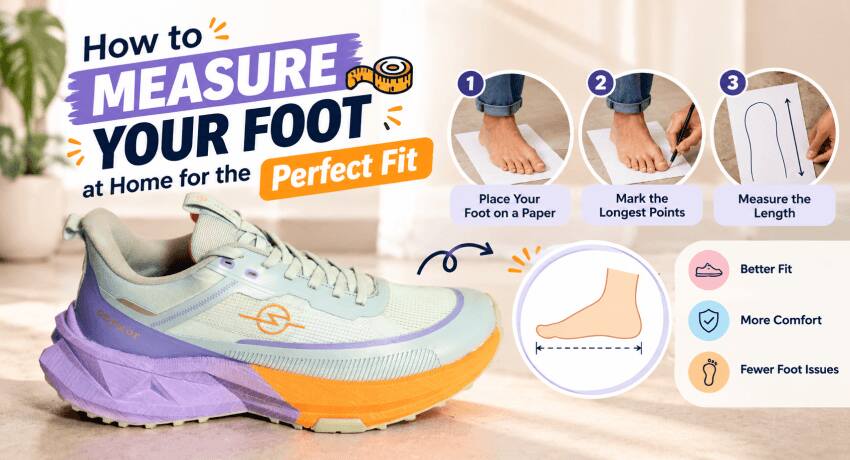
Follow these steps to measure your foot length and estimate your width accurately. Repeat the process for both feet because one foot may be slightly longer or wider than the other.

Step 1: Place the Paper Against a Wall
Put a sheet of paper on a hard, flat floor with one edge touching a wall. Make sure the paper does not move while you measure.
The wall will help you position your heel consistently and make the length measurement easier.

Step 2: Stand Naturally on the Paper
Place one foot on the paper with your heel lightly touching the wall. Stand upright with your weight distributed naturally across both feet.
Avoid measuring while sitting if you can comfortably stand, because your feet may spread slightly under body weight. If standing is difficult, ask someone to help you measure safely.

Step 3: Trace Around Your Foot
Hold a pencil vertically and trace around your foot as closely as possible. Keep the pencil straight rather than angling it underneath your foot.
If someone can help you, ask them to trace the outline while you stand naturally. This can make the outline more accurate.

Step 4: Measure Your Foot Length
Use a ruler to measure the straight-line distance from the back of the heel to the tip of the longest toe on the outline.
Your longest toe may be the big toe or the second toe. Measure to whichever extends farthest forward.

Step 5: Measure Your Foot Width
Identify the widest part of your forefoot, usually around the ball of the foot near the base of the big toe and little toe.
Measure the straight-line distance between the two widest points on the outline. This gives you a useful width estimate, although a foot tracing is not a perfect substitute for a professional width measurement.

Step 6: Repeat for the Other Foot
Repeat the entire process for your other foot. Record both measurements in centimetres or millimetres.
When choosing shoes, use the measurements of your longer foot as the starting point. If one foot is noticeably wider, also check that the shoe accommodates that foot.
How to Measure Your Foot Length Correctly
Foot length is the distance from the rearmost point of your heel to the tip of your longest toe. It is one of the most important measurements when selecting shoe sizes online.
For example, imagine your foot measures 25.2 cm from heel to toe. That number is your measured foot length, not automatically your shoe size.
The shoe size you need will depend on the manufacturer’s sizing chart, the shoe’s internal dimensions, and the amount of space the design provides in front of your toes.
Example of Foot Length Measurement
Suppose you measure both feet and get the following results:
| Measurement | Left foot | Right foot |
|---|---|---|
| Foot length | 25.0 cm | 25.3 cm |
| Foot width | 9.4 cm | 9.6 cm |
In this example, the right foot is 3 mm longer and 2 mm wider. You should begin by checking the brand’s sizing guidance for a 25.3 cm foot and confirm that the shoe also accommodates the wider foot.
Do not automatically size up by a full shoe size simply because one foot is slightly longer. First, check the brand’s chart and the actual fit.
Should You Add Extra Length to Your Foot Measurement?
You should generally use your actual foot measurement when consulting a manufacturer’s size chart. Do not add an arbitrary amount to your measurement unless the brand specifically instructs you to do so.
Shoes need appropriate room in front of the toes, but manufacturers account for that space differently. Some charts are based on foot length, while others use different sizing conventions.
For a comfortable fit, check the shoe’s intended use, toe-box shape, and fit recommendations as well as the size label.
How to Measure Your Foot Width at Home
Foot width is just as important as length for a comfortable fit. A shoe may have enough space from heel to toe but still feel tight across the ball of the foot.
A simple way to estimate your width is to measure across the widest part of your foot tracing.
What Your Width Measurement Tells You
Your width measurement helps you understand whether a shoe’s shape is likely to accommodate your foot. However, width categories such as narrow, regular, wide, and extra-wide vary between brands and sizing systems.
| Foot-width consideration | What it means when shopping |
|---|---|
| Narrow forefoot | You may need a narrower shoe or a design that holds the foot securely |
| Average forefoot | A standard-width option may work, depending on the shoe’s shape |
| Wide forefoot | Look for wide-fit options or a roomier toe box |
| Broad toes | A foot-shaped toe box may feel better than a tapered design |
| High-volume foot | You may need more space over the top of the foot, not just extra width |
Important: A foot tracing gives you a useful estimate, not a universal width classification. Two shoes marked as the same width may still fit differently because of their toe-box shape, upper materials, and construction.
How to Tell If Your Shoes Are Too Narrow
Look out for these signs when trying on footwear:
- Your toes feel squeezed together.
- The sides of your forefoot feel compressed.
- The upper stretches tightly across the widest part of your foot.
- You experience rubbing, pressure, or numbness.
- Your little toe is pushed inward by the shoe’s shape.
If these problems persist, try a wider fit or a different shoe shape instead of simply buying a longer size. Extra length does not always solve a width problem.
When Is the Best Time to Measure Your Feet?
The time of day can influence your measurements because feet may swell slightly after hours of standing or walking.
For a practical home measurement, consider measuring your feet in the late afternoon or evening, particularly if you tend to experience swelling during the day. Here are a few useful guidelines:
- Measure both feet: Do not assume they are identical.
- Wear your usual socks: This helps you account for the way you normally use your shoes.
- Stand naturally: Your foot should bear weight as it would during everyday activities.
- Repeat the measurement: Take two measurements if you are unsure about the result.
- Measure again when needed: If your footwear begins feeling consistently tight or your foot shape changes, check your measurements again.
If you have persistent swelling, pain, or a medical condition affecting your feet, seek appropriate professional advice rather than relying only on a home measurement.
How to Convert Foot Measurements into Shoe Sizes
Once you know your foot length, the next step is to find the corresponding shoe size. This is where many shoppers make mistakes: shoe sizes are not directly interchangeable across all brands or countries.
India commonly uses UK-style shoe sizing, but the sizing system and fit can vary by manufacturer. Online stores may list UK, US, and EU sizes, so always confirm which system the product uses.
Understanding UK, US, and EU Shoe Sizes

| Sizing system | How it is commonly presented | What to check |
|---|---|---|
| UK | Numeric sizes, such as UK 6 or UK 8 | Brand-specific foot-length chart |
| US men’s | Numeric sizes, such as US 7 or US 9 | Men’s sizing chart |
| US women’s | Numeric sizes, such as US 7 or US 9 | Women’s sizing chart |
| EU | Numeric sizes, such as EU 39 or EU 42 | EU conversion chart for that brand |
| Centimetres | A length value in cm | Whether it refers to foot length or a different shoe-sizing measurement |
US men’s and women’s sizes use different scales. EU and UK sizes also follow different conventions, so a simple one-size-fits-all conversion can be misleading.
An Example of Using a Shoe Size Chart
Suppose your longer foot measures 25.3 cm.
Instead of guessing that you need a particular UK, US, or EU size, follow this process:
- Open the size chart on the brand’s official website.
- Check whether the chart lists foot length or shoe length.
- Find the range that includes your measurement of 25.3 cm.
- Check whether the brand recommends sizing up or down for that particular model.
- Read any fit notes about narrow toes, wide feet, or unusual sizing.
- If you fall between sizes, use the manufacturer’s guidance and consider trying both sizes when possible.
A centimetre measurement is a helpful starting point, but it does not guarantee the same size across every footwear brand.
How to Measure Your Feet for Different Types of Shoes
Your foot measurements remain the same, but the best-fitting shoe can vary according to the activity and design.

Running Shoes
Measure your feet while standing, wearing your usual running socks. Look for adequate toe room, a secure heel, and enough width to avoid pressure during movement. Running shoes may need more room than a snug-fitting casual shoe, depending on your running style and the manufacturer’s fit guidance.

Everyday Sneakers
For casual sneakers, check both length and width. Your toes should not be squeezed, and the heel should feel secure without rubbing. Consider the thickness of your everyday socks when trying on the shoes.

Formal Shoes
Formal footwear often has a different shape from athletic shoes. A pointed or tapered toe box may feel narrower even when the length seems correct. Prioritize a comfortable toe shape instead of assuming that a longer size will fix all pressure.

Walking Shoes
If you walk for long periods, check the fit after standing and walking in the shoes for a few minutes. Your toes should have enough room to move, and the shoe should not slip excessively at the heel.

Sandals and Slippers
Check that your heel and toes sit comfortably within the footbed. Your foot should not spill over the edges, and the straps should hold it securely without creating painful pressure.
How to Measure Children’s Feet at Home
Children’s feet grow, so a shoe size that fitted comfortably a few months ago may no longer be suitable. Regular checks are more useful than relying on a previously purchased size.
Use the same basic measuring method: place paper against a wall, have the child stand naturally on it, trace each foot, and measure from the heel to the longest toe.
Keep these points in mind:
- Measure both feet, as children’s feet may differ in length.
- Use the brand’s current children’s size chart.
- Check fit while the child wears the socks intended for the shoes.
- Make sure the toes have enough room to move.
- Check that the heel stays secure while walking.
- Do not buy shoes that are excessively large just to make them last longer.
Children may not always explain that shoes feel tight, so look for signs such as toe curling, reluctance to wear the shoes, rubbing, or redness after use.
There is no single measurement interval that suits every child. Check more frequently during periods of rapid growth and whenever the shoes begin to feel tight.
Common Mistakes to Avoid When Measuring Your Feet
Even a small measurement error can affect your shoe selection. Avoid these common problems to get a more reliable result.
| Common mistake | Why it can cause problems | What to do instead |
|---|---|---|
| Measuring only one foot | The other foot may be longer or wider | Measure both feet |
| Measuring while seated | Your feet may spread differently under weight | Stand naturally when safe and comfortable |
| Using a soft carpet | The paper may shift and affect the tracing | Use a hard, flat surface |
| Angling the pencil inward | The outline may underestimate your foot size | Keep the pencil upright |
| Measuring diagonally | The result may not reflect heel-to-toe length | Measure the straight-line distance |
| Guessing from your old shoe size | Sizing varies across brands and models | Check the current size chart |
| Ignoring width | A shoe can be long enough but still too tight | Check width and toe-box shape |
| Adding arbitrary extra length | You may choose a shoe that is too large | Follow the manufacturer’s chart |
| Measuring only in the morning | Your feet may be larger later in the day | Measure later in the day if practical |
A Simple Tip for More Accurate Results
If your traced outline looks unusually large or small, repeat the process. Ask someone to help you trace your foot while you stand naturally, and check the measurement with a ruler.
If your feet have a significant difference in length or width, or if you have recurring pain, professional footwear advice may help you find a better fit.
How to Check Whether Your Shoes Fit Properly
Measuring your feet at home is a great starting point, but you should still check the actual fit when the shoes arrive. Even a correctly selected size can feel different because of the shoe’s shape, material, and construction.
Use this practical checklist when trying on a new pair.
Shoe fit checklist
0 of 7My toes can move comfortably without being squeezed.There is enough room in front of my longest toe when standing.The widest part of my foot does not feel compressed.My heel feels secure without excessive slipping or rubbing.The shoe feels comfortable when I walk for several minutes.There are no painful pressure points around my toes, sides, or instep.The shoes feel comfortable with the socks I normally wear.
Use this list when trying on shoes at home. A checked list is a helpful guide, not a guarantee of fit.Reset checklist
How Much Space Should You Leave in Front of Your Toes?
There is no single toe-space measurement that works for every shoe and activity. Many footwear fitting guides suggest roughly 1 cm of space in front of the longest toe as a starting point for everyday footwear, but the ideal amount varies with the shoe’s shape, intended use, and your foot.
What matters most is that your toes are not pressing against the front of the shoe when you stand or walk. Your foot should also feel secure rather than sliding forward with every step.
Do not use extra length to compensate for a shoe that is too narrow. If the toe box squeezes your forefoot, look for a wider or differently shaped shoe.
Frequently Asked Questions
1. How can I measure my foot at home without a measuring tool?
You can trace your foot on paper and use a ruler if you have one. If you do not have a ruler, mark the heel and longest-toe positions and compare the distance with an object of known length, such as a standard ruler borrowed from someone. For the most reliable result, use a metric ruler or measuring tape rather than estimating.
2. Should I measure my feet in centimetres or inches?
Centimetres or millimetres are convenient because many shoe brands provide metric measurements. One centimetre equals 10 millimetres, and one inch equals 2.54 centimetres. Whichever unit you use, make sure it matches the brand’s size chart.
3. Should I measure both feet before buying shoes online?
Yes. Measure both feet because they may differ slightly in length or width. Use the longer foot as your starting point for selecting the size, and make sure the shoe also accommodates the wider foot if the measurements differ.
4. Can my shoe size change as I get older?
Yes. Foot shape and dimensions can change over time due to factors such as ageing, changes in body weight, pregnancy, swelling, or other health-related factors. If your usual shoes start feeling uncomfortable, measure your feet again instead of assuming your old size is still correct.
5. How often should I measure my feet?
There is no universal schedule for adults. Recheck your measurements when buying unfamiliar brands, when your shoes begin to feel tight, or after noticeable changes in foot shape. Children’s feet should be checked more regularly because they are still growing.
6. What should I do if I am between two shoe sizes?
First, check the manufacturer’s fit recommendations and whether the chart refers to foot length or shoe length. If the brand advises choosing the larger size for your measurement, follow that guidance. If possible, try both sizes and compare toe room, width, and heel security. A larger size is not always the answer if the real problem is a narrow shoe shape.
7. How do I know if my shoes are too small?
Common signs include toes touching the front, pressure across the forefoot, numbness, painful rubbing, and persistent redness after wearing the shoes. Remove footwear that causes pain or numbness, and try a better-fitting size or shape.
8. Is foot length enough to determine my shoe size?
No. Foot length is an important starting point, but width, toe-box shape, instep height, heel fit, and the shoe’s construction also influence comfort. This is why checking the size chart and trying on footwear whenever possible are both important.
9. Can I measure my feet while sitting?
You can, especially if standing is difficult, but your feet may spread differently when they bear your body weight. If possible, measure while standing safely and naturally. If you need to measure while seated, use the result as an estimate and pay close attention to the shoe’s fit.
10. Do all shoe brands use the same size chart?
No. Shoe sizing varies between manufacturers, models, and regions. A UK 7, US 8, or EU 41 may not provide an identical fit across different brands. Always consult the specific product’s official size chart.
Conclusion
Knowing how to measure your foot at home can make buying shoes simpler, more accurate, and less frustrating. With a sheet of paper, a pencil, and a ruler, you can measure both foot length and width in just a few minutes.
The most important steps are to measure both feet while standing naturally, record the longer foot’s length, check your width, and compare the results with the shoe manufacturer’s size chart. Then confirm the actual fit by checking toe room, heel security, and comfort while walking.
Remember that your shoe size is only a starting point. Two shoes with the same size label can fit very differently, so consider the design, material, and intended activity before making your final choice.
The best-fitting shoe is not simply the one with the right number on the label. It is the one that comfortably accommodates your feet and supports the way you move every day.